


As much as I enjoy working in the archives, teaching is my foremost passion and the reason I set out to become an academic in the first place. This page offers a quick rundown of a few of the courses I've taught since graduate school. Please don't hesitate to get in touch if you'd like to see a syllabus.
Undergraduate Classes

University of Tübingen
Immigration and Migration in American History
This course explores the ways migration has shaped American identity and citizenship over time. It introduces students to a range of methodological approaches and traces the immigrant experience across the political, economic, social, and even military history of the United States. In assessing a chronological range of events, institutions, and ideas regarding race and belonging, students examine how the ongoing tension between ethnic and civic nationalism has impacted labor markets, cultural production, and even foreign policy from the colonial era to the present. Throughout, we pair analysis of historiography with a consideration of primary-source material drawn on by different approaches, which include unpublished correspondence, government reports, audiovisual productions, legislative documents, magazine articles, and census data. By the end of the course, students will be prepared to apply some historical insight to contemporary debates surrounding immigration in the United States, a topic that continues to dominate political discourse from the campaign trail to Capitol Hill.

University of Tübingen
The New Deal in Global Perspective
This course introduces students to the ways in which the New Deal reconciled democracy and capitalism in the face of major economic, diplomatic, and military crises throughout the 1930s and 1940s. Rather than give life to yet another nation-centered interpretation of the New Deal, this course invites students to consider both the domestic and international reach of the democratic administration which redefined the American experience by regulating business and agriculture, recalibrating foreign policy, introducing labor protections, and eventually mobilizing the American population for a second world war. But to what extent were certain New Deal policies distinct, national variations of a larger, transnational pattern of adaptive governance? How can the Roosevelt administration’s emphasis on cultural production and identity help us make sense of the New Deal’s ultimate goals? By the end of the course, students will be prepared to weigh in on the current historiographic debates surrounding the New Deal order and present their findings in the form of a final paper.

The Cooper Union (HTA313-F)
Public Art in Times of Crisis: Exploring the New Deal’s Cultural Legacy
This course introduces students to the ways in which the New Deal reconciled democracy and capitalism in the face of major economic, diplomatic, and military crises throughout the 1930s and 1940s. Specifically, it offers an overview of the development and function of the Federal Art Project (FAP), a federally sponsored cultural program intended to provide employment for struggling artists during the Great Depression. Created as a relief measure to employ artists and artisans to create public murals, easel paintings, sculpture, graphic art, posters, and photographs, this initiative remains one of the most understudied New Deal programs created to alleviate economic strain and give form to a sense of national culture. By the end of the semester, students will be prepared to weigh in on the current historiographic debates surrounding the FAP and its cultural legacy. Students will learn to navigate the New Deal-era Index of American Design, explore largescale examples of FAP-sponsored museum and stage design, and take stock of local arts and crafts initiatives launched in the midst of the Depression.

University St Andrews (MO4810)
Approaches to the American Century
This two-semester course surveys recent scholarly approaches to the “American century,” Henry Luce’s famous 1941 term for U.S. global leadership. In semester one we will focus on the role of the federal government in projecting U.S. power abroad during the twentieth century through diplomatic, military, technological, economic, and cultural means. Semester two explores American interactions with the world from the perspective of non-state actors ranging from tourists and students to businesspeople and philanthropists to artists and activists. We range widely across the historiography of American power, scrutinizing it through the lenses of diplomatic history; cultural history; the history of technology; social history; the histories of gender and sexuality; environmental history; and other approaches.

University St Andrews (MO3359)
The United States in the Cold War and the Cold War in the United States
This course covers the history of the United States and the Cold War in both international and domestic contexts. First, we will examine the Cold War as Washington’s guiding foreign-policy framework for nearly a half-century after World War II, a diplomatic and ideological standoff that fomented hot wars on several continents and economic and cultural policies designed to “win hearts and minds” around the world. Second, we will consider how the Cold War both propelled and constrained changes in American politics, culture, and society. Case studies will include the Red Scare and the Lavender Scare, the Cuban Missile Crisis, the domestic politics of containment, and the impact of U.S.-Soviet tensions on the American civil rights movement.
Graduate Seminars

University of St Andrews (MO5153)
History in the Making: Theories, Approaches and Practices
The module examines the development of history-writing and historical research since the Enlightenment, and the emergence of fields, trends and new approaches in current historiography. It brings together material from a range of historical approaches in order to provide a strong introduction to history and historiography at postgraduate level. Its combination of substantive and historiographical material enables the module to be used as a free-standing guide for those humanities students who are not based in History but who wish to take an elective module in the subject.

University of St Andrews (MO5626)
Global Times, Plural Spaces
This team-taught course offers a strong foundation in the major approaches to comparative and transnational history as well as the emerging field of spatial history. I led the sessions related to archival research and primary source adoption.
Undergraduate Surveys and Lectures

University of St Andrews (MO1008)
Themes in Late Modern History
This module provides thematic coverage of major political and social developments during the 19th and 20th centuries. By adopting a thematic rather than chronological structure, it highlights continuities and ruptures in modern global history, with an emphasis on comparative approaches to subjects like revolution, ideology and rapid social and cultural change that have shaped the modern world.

Florida State College at Jacksonville
United States History to 1877
In this course, students examine United States history from before European contact to the 'Corrupt Bargain' of 1877. Topics include Indigenous culture and society, the Colonial Period, the American Revolution, the Constitutional Convention, federalism, sectionalism, slavery, manifest destiny, the American Civil War, and Reconstruction.

Florida State College at Jacksonville
United States History from 1877
In this course, students trace the history of the United States from the end of the Reconstruction Era to the present. Topics include the rise of industrialization, the United States' emergence as an actor on the world stage, constitutional amendments and their impact, the Progressive Era, World War I, the Great Depression and New Deal, World War II, issues of civil and minority rights, the Cold War, and the ongoing American intervention in the Middle East.
Santa Fe College
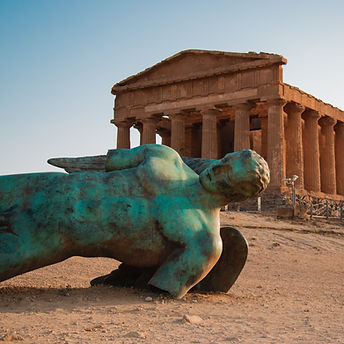
Material Culture from Antiquity to the Renaissance
This course introduces students to several dominant themes (architecture, art, literature/drama, philosophy, politics/war) throughout the history of so-called ‘Western culture.’ Specific attention is paid to the ways in which
these themes were reflected or, perhaps, projected, across various elements of material culture. Though geographically limited in scope, this course considers over two-thousand years' worth of cultural production from Ancient Greece to the European Renaissance.

Santa Fe College
Introduction to the Humanities
Through exposure to a variety of the humanities such as the arts, literature, music, dance, painting, theatre, and philosophy, this course introduces students to the historical development of the humanities. By the end of the course, students will be able to identify major movements and thinkers within the liberal arts and analyze works within the humanities, both with reference to other, similar works and as individual objects of study.

Manchester Community College
Introduction to the Humanities
Through exposure to a variety of the humanities such as the arts, literature, music, dance, painting, theatre, and philosophy, this course introduces students to the historical development of the humanities. By the end of the course, students will be able to identify major movements and thinkers within the liberal arts and analyze works within the humanities, both with reference to other, similar works and as individual objects of study.